loader image
Zum Hauptinhalt
Wenn Sie weiter auf dieser Webseite arbeiten möchten, bestätigen Sie bitte unsere Nutzungsrichtlinie:
  • Datenschutzerklärung & Nutzungsbedingungen für PAUL
Fortsetzen
x
  • Kategorien
    • Alle Kategorien
    • Allgemein
    • Darstellende Künste und Film
    • Design
    • Fine Arts
    • Kulturanalysen und Vermittlung
    • Musik
    • Projekte
    • Weiterbildung
  • Startseite
  • Kalender
Deutsch ‎(de)‎
Deutsch ‎(de)‎ English ‎(en)‎
Sie sind als Gast angemeldet
Login
Kategorien Einklappen Ausklappen
  • Alle Kategorien
  • Allgemein
  • Darstellende Künste und Film
  • Design
  • Fine Arts
  • Kulturanalysen und Vermittlung
  • Musik
  • Projekte
  • Weiterbildung
Startseite Kalender
Alles aufklappen Alles einklappen
Kursmenü
      Design

      Bachelor Thesis 2021

      Duy Bui Duy Bui
      Florian Bruggisser Florian Bruggisser
      JB Joëlle Bitton
      Jürgen Späth Jürgen Späth
      Alle anzeigen
      • Design

        Bachelor Thesis 2021

        Duy Bui Duy Bui
        Florian Bruggisser Florian Bruggisser
        JB Joëlle Bitton
        Jürgen Späth Jürgen Späth
        view all

        Bachelor Thesis 2021

        Bachelor Thesis Semester

        Mehr Weniger anzeigen
        • forum icon
          Ankündigungen Forum
        • zoom icon
          Progress Sessions / Colloqium Zoom Meeting
        • page icon
          Mentorings Textseite
        Mehr
      • General Informations

        • Mentors

          Bachelorthesis

          Prof. Jürgen Späth / Florian Bruggisser

          Prof. Dr. Karmen Franinovic / Luke Franzke

          Dr. Joëlle Bitton / Stella Speziali

          Dr. Roman Kirschner / Mona Neubauer


          Video/Audio

          Nicole Fölsterl

          Matthias Kappeler


          Coordination

          Marcial Koch


          External Jury

          Rea Eggli

          Christoph Schmid


          Attendance

          Attendance to all presentations is mandatory for all BA-finals candidates.
          All monthly general presentations are open to all BA IAD students.
          BA finals are open to ZHdK audience and friends.


          Preparation - Fall Semester

          • Free Flow Retreat
          • Sweet Dreams Are Made of This (Theory course)
          • BA Thesis Concept Seminar

          • Thesis disposition and statement

          2-page essay delivered by 10 December 2020, 17:00.

          This document presents your intention of thesis and the statement you want to make.

          It helps show your future contribution as a Bachelor student in Interaction Design to this field of knowledge.

          The document should contain the following: 

            • Title / Author
            • Abstract (1 short paragraph summarising your proposal)
            • Answers to those questions:
          - What is the topic/issue/phenomenon that you aim to investigate?
          - Is it a problem that you want to solve or an opportunity that presents itself?
          - What research questions could you ask or what statements could you make?
          - What methods would you use to to answer the questions or prove your hypothesis?
          - What is your motivation for investigating this topic?
          - What makes you a suitable investigator?
          - What difference would you make compared to prior projects who addressed this topic?
          - What contribution do you hope to make?


          Expenses
          Please be aware that your expenses can only be refunded if you submit the complete documents no later than 4 weeks after the end of the module. Regarding this module every student has a budget of 500 CHF, which will be reimbursed after the course.


      • Dates & Deadlines


        The timeline provides a general overview of the BA thesis semester. However, it is no longer updated. For the exact dates please have a look at the Google Calendar below.

        • 10 December 2020, 17:00

          • Statement & project disposition (2-page essay)
            Make a stand: what contribution do you want to make?

          22 January 2021, 17:00 (BA Thesis Concept Seminar - final session)

          • Development of intention (3-5-page essay)
          • Initial project 'pretotype' & video
          • Choice of mentoring team (send 1st & 2nd choice to Marcial Koch)

          22 February 2021, 10:00–11:00

          • Semester overview

          24 & 25 February 2021, 09:00–17:00

          • Progress session 1 «Background and Related Work»

          01 March 2021, 17:00

          • Thesis structure (Structure of your thesis, commented - 2 pages)
          • Chapter Research field: Background/context, literature review and related work, situating work in relation to theory & practice, field of contribution
          • Advanced prototype

          11 March 2021, 09:00–11:00 [Diploma exhibition]

          • «Informationsanlass» in Konzertsaal 3
          • Einführungsveranstaltung DDE

          19 March 2021, 13:00 - 16:00  [Diploma exhibition]

          • Exhibition workshop

          22 March 2021, 17.00

          • Chapter Concept
          • More advanced prototype

          24 & 25 March 2021, 09:00–17:00

          • Progress session 2 «Early Findings and Prototypes»

          29 March 2021, 17:00 [Diploma exhibition]

          • Send exhibition concept incl. requests and orders for exhibition locations, furniture, plinths, and iMacs/iPads to Marcial Koch (marcial.koch@zhdk.ch)

          06 April 2021, 17:00 [Diploma exhibition]

          • Confirm requests and orders for exhibition locations, furniture, plinths, and iMacs/iPads via Mail to Marcial Koch (marcial.koch@zhdk.ch)

          12 April 2021, 12:00 [Diploma exhibition]

          • Deadline «AVZ Geräte», order equipment like projectors, headphones, media players etc. (excl. iMacs/iPads) via online form (detailed information are given at «Informationsanlass»)

          12 April 2021, 23:59

          • First storyboards on server

          15. & 16. April 2021, 09:00 - 17:00

          • Storytelling mentoring Nicole and Matthias, invitation per Doodle

          20 April 2021, 17:00

          • Chapter Project Development

          21 & 22 April 2021, 09:00–17:00

          • Progress session 3 «Observations and Lessons learned»
          • Exhibition Layout review to all mentors and students by Marcial Koch (at the beginning of Progress session 3)
          • Students present their video concepts/storyboards (2 min)
          • Send address list for invitations «Business-Apéro» event on xx xx 2021, xx:00 @tbc to Marcial Koch (marcial.koch@zhdk.ch)
            (invitation to companies, industry contacts, offices, agencies and friends)

          30 April 2021, 17:00
          • BA: Upload pictures and abstracts for diploma publication on server
          • MA: Send pictures and abstracts for diploma publication to your mentors and Marcial Koch (marcial.koch@zhdk.ch)


          06. & 07. May 2021, 09:00 - 17:00

          • Storytelling mentoring Nicole and Matthias, invitation per Doodle

          07. May 2021, 16:00 [Diploma exhibition]
          • Revised storyboards on server
          • BA: Upload updated abstracts for diploma publication on server
          • Final approval by Jürgen Späth
          • Rental Equipment AVS-Ausleihe (only for video production / optionally)

          11. & 12. May 2021, 09:00–17:00

          • Video mentoring Nicole and Matthias, invitation per Doodle

          17 May 2021, 17:00
          • Chapter Conclusion (full thesis including updates and rewrites, not designed)
          • Storyboard Feedback from Mentors

          18 May 2021

          • Morning: optional mentoring (Matthias Kappeler & Nicole Fölsterl)


          19 May 2021

          • Morning: optional mentoring (Matthias Kappeler & Nicole Fölsterl)

          19./20./27. May 2021

          • Photostudio Toni-Areal reserved for IAD Diploma (optionally)


          24 May 2021, 17:00

          • deadline for video rough cut (on server)
          • Upload updated teaserimages/main image + 5–10 images for diploma publication on server

          25. & 26. May 2021, 09:00 – 17:00

          • Post Production mentoring (Matthias Kappeler & Nicole Fölsterl)
          • If required: refresh colour grading in the afternoon (Matthias Kappeler)

          28 May 2020, 14:00 tbc [Diploma exhibition]

          • Briefing BA- and MA-finals for build up exhibition @tbc

          31 May 2021, tbc  [Diploma exhibition]

          • Start build up Exhibition

          01 & 02 June 2021, 09:00 – 17:00

          • Thesis Colloquium 
            Each student/team meets the main mentors together for a session. Each student explain briefly what their findings are (max. 5 min per student) and then we have a discussion (mentors ask questions) about the work and the process (15 min).
            Sessiontiming:
            Single - 20 min
            Tandem - 25 min
            Tandem+ - 30min

          07 June 2021, 14:00
          • Visit through Exhibition, possible adjustments of scenography


          08 June 2021, 17:00

          • Full BA thesis text and documents delivered (including updates and rewrites, with final reflection on practice)
            • Please hand in two hard copies of your thesis to Marcial Koch, IAD office room 4C.01, until 17.00.
            • Digital copy on the IAD server by 17.00.
          • Final video delivery on server

          10 June 2021, 17:00 – late

          • Vernissage
          • Opening speech (Prof. Dr. Thomas D. Meier & Corina Zuberbühler)
          • Opening IAD «exhibition» with apéro (details tbc)

          11 June 2021, 10:00 – 14:00

          • Clear-out work space student atelier 4.K22 (only BA)

          15. - 16.  June 2021, 09:00 - 17:00, tbc

          • BA Finals
          • Mentors and Jury discussion

          17 June 2021

          • Final mentors and jury discussion
          • Thesis Students feedback session, (ca. 10 min / project)
          • Sommerfest

          21 June 2021, 17:00

          • All Deliverables on server - all files which aren't on the server yet, including project images, pdf documentation, codes, prototypes (if digital) etc.

          24. June 2021, 18:00 - 19:00
          • Business-Apéro, further Informations will come, but it will be digital

          25 June 2021

          • Diplomfeier? tbc (detailed information will follow)

          26 June 2021

          • Exhibition take-down
          • Return the AV devices (@ ZHdK-Ausleihe 1.D26, 09:00–16:00)
          • Return iMacs/iPads (@ IAD office, 09:00–12:00) Important: bring to the office before 12:00!

          28 June 2021

          • Exhibition take-down
          • Return the AV devices (@ ZHdK-Ausleihe 1.D26, 09:00–16:00)
          • Return iMacs/iPads (@ IAD office, 09:00–12:00) Important: bring to the office before 12:00!
          • Final clear-out work space student atelier 4.K22 (only BA).

      • Document Structure & Criteria

        • General

          The thesis raises the claim of a scientific work and as a historical, conceptual or ethnographic examination goes beyond the framework of a project documentation or a workshop report by developing independent and relevant theses for design, economy, society and culture. It is based on profound research and an in-depth, innovative examination of the chosen topic. The length of the work should be between 12,000 and 16,000 words. In the case of tandem project, the volume is doubled and lies between 24,000 and 32,000 words. For a tandem+ project (three people) it is three times more, so 36,000 - 48,000 words. The work should be designed in a suitable format and submitted in printed and digital form.


          Structure

          These are structural guidelines for your final BA written work.

          Front Page

          Imprint

          Title: Title 
          Author: First Name Last Name, …
          Matrikel-Nr.: 0000
          Date: June 2021
          © Zurich University of the Arts, Department Design, Interaction Design
          Mentors: First Name Last Name, …
          Typeface: Name

          Abstract (50-100 words) - general insight into the topic, project and findings

          Acknowledgments

          Table of Contents

          Main Content

          Format of the organisation is flexible but it needs to feature:

          General Introduction 

          ----- Your research field (2000 words)
          Background and Context
          Research Questions - Hypothesis
          Methodology chosen for your investigation
          Motivation and Intended Contribution 
          Chapter Overview (narrative or organisation of your content)

          ----- Your concept (6000 words)
          Concept and Angle
          Related Projects
          Field Research (interviews, user studies, observations. // technology inquiry // etc)
          Findings and Next Steps

          ----- Project Development (6000 words)
          Experiments 
          Prototypes (incl. user tests if applicable)
          Results (incl. user tests if applicable)

          ----- Conclusion (2000 words)

          Contribution  
          Future Steps

          ----- Bibliography (no word count)

          Bibliography

          Organised alphabetically by order of source genre: book, book chapter, journal article, conference article, academic thesis, newspaper article, web article, etc.

          Accepted styles: APA, CMS, or other or refer to the document ba_thesis_viad_2017.pdf for details for each type of reference. The important part is when you choose your style to be consistent and homogeneous throughout.

          Usually, you can follow this guideline: Last name, First name. Date. Title. Publisher. 

          For book chapter, journal and conference papers, study, etc. It's usually Last name, First name. Date. "Title of article". In book title or publication. etc.

          For web URLs, you need to feature the link, the author(s) of the article/reference featured in the link, the date it was created, AND the date you retrieved the information.


          Additional elements

          You should feature at the beginning acknowledgments, especially if you worked with users and participants, if you benefited from all sorts of support, including your mentors lächelnd etc.

          At the end, if needed, add an annex with additional documents.

          Number your pages.

          It's good practice to add a header throughout with the title of your document and the current chapter.

          Footnotes should be used sparingly and only if they have a strong added value.


          Citation and Images

          Text and Numbers

          Provide the source for all references you're making throughout the document, images, data statistics, quotes, arguments supported by theories and case studies.

          Citation are made throughout the text by putting in brackets the name of author, year and page if it's a quote or a precise argument. 

          Ex. (Deleuze 1974: 53) 

          For two authors, the two names are mentioned e.g. (Deleuze & Guattari 1973)

          For more than two authors: (Deleuze et al 1974)

          The name and year then refer to the bibliography at the end.


          Image Caption

          All images have to be captioned either directly below the image or in a table of illustrations that list all images used with the page where they're used or the numbers that they have. Images should be captioned with title, year, author of project, author of image (this can be two different authors), where it's been retrieved from and when (website link) or other source. In the case of an art piece, mention the format, the material ("net art", "oil on canvas", etc) and if appropriate where it is hosted (museum, gallery, etc).


          Authorship

          In case of two students authoring the document, please mark clearly each student's contribution. You are free to choose how you want to mark it, one possibility might be to reserve a part of the thesis for this purpose.

          More about Plagiarism here.


          General Literature

          • Merkblatt für die Abfassung von schriftlichen Arbeiten im DDE: 
          • Organisation of references
          • Schreibtrainer der Uni Essen

          • Jürg Niederhausen, Duden: die schriftliche Arbeit, 4. ed. (Mannheim: Duden-Verlag, 2006). Wolfgang Weimer, Logisches Argumentieren (Stuttgart: Reclam, 2005).
          • Kate L. Turabian, A Manual for Writers of Research Papers, Theses, and Dissertations: Chicago Style for Students and Researchers, 7th Edition (Chicago: Chicago University Press, 2007).
          • Otto Kruse, Keine Angst vor dem leeren Blatt: Ohne Schreibblockaden durchs Studium (Frankfurt am Main: Campus Verlag, 2004).
          • Michael Harvey, "Nuts & Bolts of College Writing (Indianapolis, IN: Hackett Publishing, 2003).
          • Christian Boulanger and Raimund Krämer, Wissenscha!liches Schreiben (Potsdam: Universitätsverlag, 2005).
          • Nigel Warburton, Basics of Essay Writing (London: Routledge, 2006.


          Example of how to combine theory and practice in a thesis

          • Making Spaces: How Design Worksbooks Work
          • Attention To Detail: Annotations of a Design Process
          • The Presence Project


      • Presentations & Guidelines

        • 3 group presentations

          Presentation of advancement of project as well as theoretical research, together with all students and all mentors. Presentation should all be 5 minutes long with 10 minutes for feedback and discussion. Format is free - although slides are most useful to structure your presentation. See presentation guidelines below.


          Wednesday 24. & 25. February 2021: Progress session 1 «Background and Related Work», 09:00–12:00, Zoom

          5 min per student / 7 min per tandem / 9 min per tandem+ & 10 min discussion each

          • Present status of your thesis concept
          • Analysis of existing situation, experience or technology
          • Present related work and how you situate your project in comparison
          • Present advanced prototype


          Wednesday 24. & 25. March 2021: Progress session 2, «Early Findings and Prototypes», 09:00–12:00, Zoom

          5 min per student / 7 min per tandem / 9 min per tandem+ & 10 min discussion each

          • Advanced research from user studies if applicable
          • Present data and main findings
          • How will this inform your concept, problem or design opportunity? Based on your findings, inform or enhance your concept.
          • What kind of prototype is the most suitable for your project?
          • What kind of prototype helped you find the main findings/observations?
          • What do you hope to achieve with your prototype?


          Wednesday 28. & 29. April 2021: Progress session 3, «Observations and Lessons learned», 09:00–12:00, probably zoom

          7 min per student / 9 min per tandem / 11 min per tandem+ & 10 min discussion each

          • Present your final exhibition concept and project
          • Present your video storyboards (max. 2 min)
          • Final Observations from user studies
          • Present 3 main lessons learned from your process
          • Present your contribution to the field

          Oral Presentation style

          • BA Finals:
            1 student: 15 minutes presentation (theory + practice) + 10 minutes discussion/feedback
            2 students: 17,5 minutes presentation (theory + practice) + 12,5 minutes discussion/feedback (additional 5 min in total)
            3 students: 20 minutes presentation (theory + practice) + 15 minutes discussion/feedback (additional 10 min in total)
          • Present in English or German
          • Think of your presentation as a performance: try to not learn your text by heart, but rather practice enough that you can present with a natural conversational flow
          • Start the presentation by reminding briefly the audience what your project is about
          • Slides are recommended - other formats are possible - please check with us beforehand
          • If you do use slides, don’t read all the text that is present on the slides, summarize your thoughts
          • Go to the point, be concise, cut the non-essential parts in your speech
          • Don’t lose time describing what is presented on the screen (we can understand by looking at the slides)
          • Respect the time - don’t be afraid by the “short” time - it’s plenty enough if you keep to the essence of your ideas. 
            If you use these minutes well, you won’t have to rush through what you have to say. Don’t think that all you have to say matters, you can always be more concise.

          Slides style
          • The text should be readable (font minimum at 24 or 36 pt), in a readable colour over a readable background.
          • Don’t crowd your slides with text - usually keep it to 1 strong idea = 1 slide.
          • For every statistics, photo, reference, quote, statement (including your own), you need to state the complete source and date in a readable caption.
          • Be careful of typos in your text

          Computer and demo ready
          • Prior to the start of the class or during the break, test your computer on the room projector & sound if you need it
          • 2 minutes before the current presenter is finishing, be ready to start. Any time that you’ll get your computer ready once it’s your turn, it will be discounted from your overall time. Have your slides ready on screen, do not search for them in a folder.
          • Be sure your computer is charged, that a screensaver is not running, that apps such as Mail, Flux or other interruptors are not running in the background
          • Have a backup of your slides on the server in case you get a computer crash
          • If you present videos or sounds during the presentation, have them embedded in your presentation or make sure the external links are loaded. Limit your video excerpts to 30 seconds or 1 minute at most.
                       
          Structure and outline of the final presentation

          Whether you're using slides or not, this is the narrative that we recommend for your BA final presentation:

          • First slide should feature: Your Name, Project title, School, Department, Mentors, potential Collaboration partners, Date
          • Second slide is stating in 1-2 short sentences: your project summary (what is it?) and why it’s ground-breaking
          • Describe your project a bit further: what are the interactions within the project, how do users experience it? You can present here as well a very short demo of your project if relevant
          • Background Research / Related Projects: This can pertain to various categories: eg related background in sciences, in history, in art, in design, in technology, in the aesthetics, in the concept, in literature/science-fiction, etc… Pick the most relevant projects and mention how your project extends/pushes the topic further.
          • Experiments / First Tests
          • Decision-making process: How did you make the decisions you made? Define the 2-3 key moments in your process.
          • User-studies: Who are your users, how did you involve them and how their input helped you make decisions for your project?
          • Reflections on the project and contribution to the field
          • Potential impact & future directions

      • Final Project Criteria & Grading

        • The official study guidelines of the BA in Design at ZHdK provides broad lines for the diploma evaluation (see § 15).

          The BA thesis is composed of two aspects:
          - the BA project, with a process, outcome and findings presented and exhibited counts for 22 ECTS points.
          - the BA written work and documentation counts for 6 ECTS points (including a discussion during the thesis colloquium) and the criteria are listed here.

          Another criteria for getting your diploma is a full project documentation (incl. images, texts, video, prototype, etc.) on the ZHdK-server. Guidelines are the same as for other projects in the IAD. Please be aware that we can not hand out a diploma to those who do not completely fulfill this requirements.

          Criteria for the BA project
          • Project (50%)
          Content
            • Generosity: How the research was conducted with ambition, commitment and responsibilty.
            • Relevance: Relevance of the topic for the design community, society, design discourse.
            • Execution: Quality of the methodology, Quality of research and investigation, Experiments conducted, Adequate design tools
            • Academic Position: Evaluating the maturity of the position within the research discourse. 
            • Transversality: Considering the different fields in which the project can have an impact.
            • Overall impression
          Format
            • Correct execution of formal aspects such as quotations, bibliography, sources, etc.
            • articulation, linguistic translation and differentiation
            • visual and design elements

          • Final presentation (25%)
            Ability for Synthesis 
            Range of Overview given
            Addressing questions asked

          • Mediation via exhibition (25%)
            Quality
            Precision

          The grade is decided after each mentoring team provides their assessment (the student mentors provide a consultory assessment) and a discussion leads to a consensus.
          The two external guests provide their assessment for the project itself and for the mediation via exhibition.

          Additional criteria
          Depending on the angle undertaken for the project, some aspects will be particularly relevant: ie. interface design for apps and platforms, methodology for field studies, evaluation for education services, etc..

          Grading details
          A hervorragend (6) = ausgezeichnete, hervorragende Leistung 
          B sehr gut (5-6) = deutlich überdurchschnittliche Leistung 
          C gut (5) = insgesamt gute und solide Arbeit 
          D befriedigend (4-5) = mittelmäßige Arbeit 
          E ausreichend (4) = Leistungen entsprechen den Mindestanforderungen 
          FX nicht bestanden (3,5) = es sind Nachbesserungen erforderlich 
          F klar nicht bestanden (<3,5) 
          Abstufungen: 3 = ungenügend, 2 = schwach, 1 = sehr schwach bzw. keine Arbeit geleistet – die Arbeit ist zu wiederholen, in der Regel keine Nachbesserung möglich.


      • Deliverables

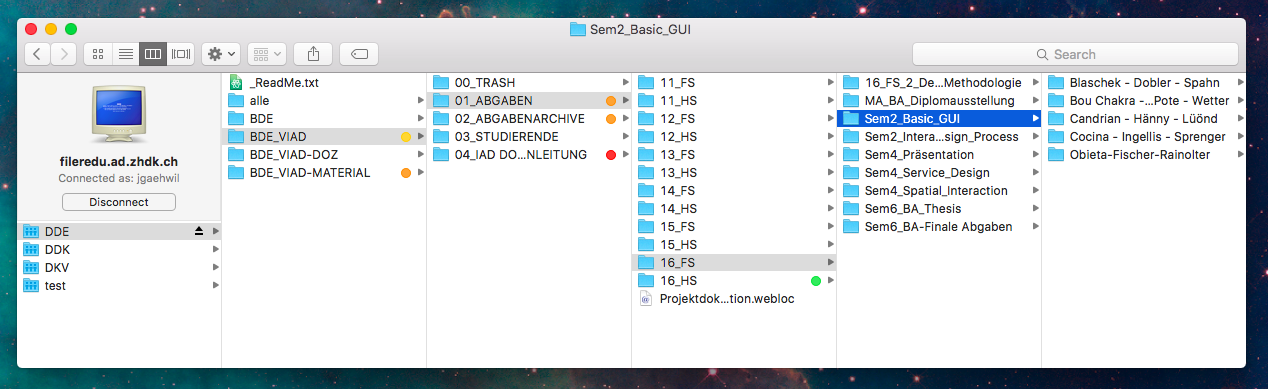
        • All document deliveries should be made on the IAD server. See screenshot.


          Documentation deliverables

          Despite the deliverables you have to hand in during your process, including the full thesis (PDF), there is a mandatory documentation of your BA final project. In general, it's the same as for every other project. The guidelines can be found here: Project Documentation.

          Upload the following deliverables to the server by 21 June 2021, 17:00:

          • Text
            • Project title, max. 100 characters
            • Short description, min. 250 – max. 400 characters
            • Project description, min. 1000 characters
            • Contributors, full names of students and mentors
          • Images
            • min. 10 high-res images showing different aspects of your work/prototype
            • min. 10 high-res images showing your process
          • Video
            • include official IAD intro and closing credits
          • Prototype (if existing, f.e. Figma files, code, etc.)


      • Project Documentation

        • Project Documentation Guidelines and Storage Filer

          Project documentations are collected on the university-wide file server (filer). Submission details are announced by lecturers, but usually comply with the following requirements: 

          • Text file including the project title, names of students and mentors, a short description, and a project description (in a file to be labelled “Texts”)  
          • Approx. 10 representative images of the project (to be stored in a file labelled “Images”)
          • At least one short video (~2min) of the project (to be stored in a file labelled “Video”)
          • A PDF documentation (to be stored in a file labelled “Documentation”)
          • Additional raw data, e.g., presentation, prototypes, or codes (to be stored in the respective file).


          Media Archiv

          The Media Archive is the platform for collaborative work, sharing and archiving of media at the ZHdK. It is available to students, lecturers and staff. In addition to the storage on the university-wide file server (filer), archiving the projects - especially diploma theses - on the Media Archive is mandatory for students. You can find a specific manual how to upload your project documentation to the Media Archiv here.


          Filer Access

          Filer access is via the internal ZHdK-Login. Note that access is restricted to the Toni Campus or via a VPN connection.

          The IAD directories are stored on the DDE volume: smb://zhdk;username@fileredu.ad.zhdk.ch/DDE.


          Server Data Structure

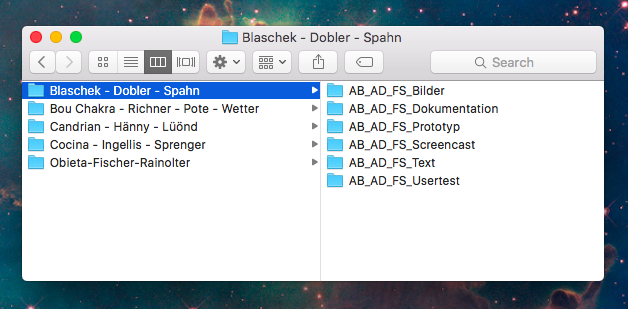
          Documentation must be submitted via the following directory: DDE > VIAD > ABGABEN. In addition, submissions are sorted by course in the corresponding semester directory (XX_FS, XX_HS):


          Naming Files and Folders

          Folders on the 1st hierarchical level should bear the name of the student or of the student group. First and last names must be separated by a space. Use „ - “ to separate the names of projects involving two or more students. Use last names only for groups (i..e, more than 3 students).

          From the 2nd hierarchical level, folders and files should only bear initials. Use the underscore sign to separate initials from further names. Folders containing your project groups are stored on this level. We have illustrated the structure with a group submission. In all other cases, create three files beginning with your initials and separated by an underscore sign. Use an underscore sign and the folder title after your initials.


          Naming Images

          Images should be labelled with a number and an unambiguous term. Numbering begins with 01. Use an underscore sign to separate numbers and terms.


          Submitting various media

          Text

          Create a text file containing the following information, which is required for the IAD website. Also include all closing credits appearing at the end of your video.

          Text files may be submitted in English and/on in German and should contain: 

            Project title
            max. 100 characters
            Short description
            min. 250 - max. 400 characters
            Project description
            min. 1000 characters
            Contributors
            full names of students and mentors

          Images

          Images must be stored at high-resolution:

            Version   High-resolution
            Format   JPG
            Resolution   max. 4000x4000
            Quality   Maximum
            Size   max. 6MB

          Audio

          Audio recordings should have the following properties:

            Sample rate   48 KHZ
            Format   WAV / AIFF
            Bit rate   16 / 24 Bit

          Video

          We ask you to add the IAD intro and closing credits to your videos.

          You can download the self-explaining Adobe Illustrator file here: video intro and credits template.ai.
          Or you can find it on the server under: smb://fileredu.ad.zhdk.ch/DDE/BDE_VIAD/04_IAD DOKUMENTATION ANLEITUNG /IAD video intro/credits template/video intro and credits template.ai.

          Use the following video settings:

            Resolution   1920x1080 (1080p)
            Format   MPEG-4 (.mp4) / Quicktime (.mov)
            Video Codec   H.264 (best quality)
            Image rate   25 FPS
            Audio Codec   AAC (Advanced Audio Codec)
            Sample rate   48 KHZ
            Preset (Adobe)   H.264 > HD 1080p 25


          Credits and Acknowledgements 

          All collaborators, mentors and teachers, users, participants, sponsors should be credited and acknowledged for their contributions. 
          All projects mentioned, sounds, images and references used should be dated and credited (see sections on plagiarism and copyrights).


          Referencing style

          Chicago Social Sciences


      • Plagiarism & Copyrights

        • Plagiarism

          We take issues of plagiarism very seriously, whether in the case of theoretical work or practical work.

          Students shown to have plagiarised work will get a failing grade in the first case, and if it happens a second time, they will go through a reviewing commission that will decide on their status as a student of the IAD BA program.

          A word about plagiarism (excerpt from ba_thesis_viad_2017.pdf): 

          Gemäss Allgemeiner Studienordnung (ASO) § 16 haben Studierende ihre Leistungen eigen- ständig zu erbringen. Die Verwertung nicht deklarierter fremder Arbeitsergebnisse (z.B. Plagiate) gilt als unredlich. Unredliche Leistungen werden als nicht bestanden bewertet. Ein Ausschluss des fehlbaren Studenten, der fehlbaren Studentin von der ZHdK ist gemäss ASO § 24 Abs. 2 möglich. (Beschluss der Hochschulleitung 11.05.2011) 

          The Interaction Design Programme considers plagiarism to constitute the violation of any intellectual, visual, or acoustic property pertaining to the copyrighted pictorial-, video-, and sound material created by any third party. Plagiarism also includes the unauthorised use of any scientific findings, hypotheses, teachings, or research approaches under presumption of authorship.

          In order to avoid plagiarism, the appropriate source must be indicated for each text passage, thought and idea of a foreign author. Indirectly cited text passages and thoughts must also be given a reference. Only your own thoughts and ideas, as well as generally known facts ("A day has 24 hours") do not require a reference.

          In addition, we expect students to quote or mention work that constituted an inspiration or can be categorised as related work.


          Copyrights and Licencing (Use of sound/music, other files)

          Use of Sound/Music

          It is strictly prohibited to use created by third parties without obtaining the respective rights of use. Solely the use of music for teaching purposes is permitted in accordance with applicable copyright law.

          IAD staff and students have access to the outstanding music produced by ZHdK-based composers (existing and specially composed pieces), especially from the department Film Theater und Medien (FTM). Contact Matthias Kappeler for more information.

          In addition, there are a number of online music repositories (often referred to as “mood music” or “production music”). Such repositories are subject to more open licensing (e.g. Creative Commons) and are available at affordable conditions or partly even free of charge:

          • https://licensing.jamendo.com/de/katalog
          • http://freemusicarchive.org/
          • http://www.bensound.com 
          • http://www.soundzabound.com
          • http://www.ccMixter.com
          • http://www.freesound.org
          • http://www.opsound.com
          • http://www.proudmusiclibrary.com
          • http://www.soundtaxi.net/
          • https://www.youtube.com/audiolibrary/music
          • https://www.sonicliberty.com


          IMPORTANT: Not all providers are serious and have honest intentions. Also, they require users to accept terms and conditions that the university’s legal services are unable to verify in each and every case. Most “free music” is subject to licensing fees if accessed online or in public, or if synchronised on video. SUISA fees might also be levied. Please ensure that you check both the applicable terms and conditions of use (eg. Creative Commons) and the provider’s cost model, and proceed accordingly, before using tracks.

          It is sometimes worth contacting SUISA directly, since in the case of multimedia licenses there is a certain leeway in interpreting publishing platforms and their reach.

          A SUISA guide is available.

          Professionally produced GEMA/SUISA free production music for about 50-100 CHF (30 sec.) with an excellent user interface can be found for example at Sonicliberty. The tracks can be used freely before the release and must be licensed only after release.

          In case of doubt, please contact ZHdK Legal Services.


          Uploading / File Sharing

          Time and again, cases emerge of students in particular downloading and distributing films via file sharing. Such practices often prompt copyright holders (especially US production companies - eg. Paramount Pictures) to take legal action. Uploading copyrighted materials using file sharing (especially bit torrent technology) is prohibited in Switzerland. Zurich University of the Arts (ZHdK) declines any liability whatsoever for such practices. Responsibility lies entirely with any individual who infringes against applicable law. Individuals must also bear the costs of any legal proceedings arising in connection with unlawful behaviour. ZHdK cannot be held accountable for such actions and would be required to divulge the names of those responsible in any formal procedure. ZHdK reserves the right to take disciplinary action against any persons who violate applicable legislation. 

          ZHdK draws attention to its IT User Regulations, according to which uploading and file sharing are strictly prohibited (see clause 3.5). Based on these regulations, ZHdK reserves the right to adopt disciplinary measures and sanctions in case of contravention (see clause 9).

          If you have any questions, please contact either Barbara Flaad (ITZ, service.itz@zhdk.ch) or Mischa Senn (Head of Legal Services, mischa.senn@zhdk.ch)


          Licensing 

          Here are some examples of licensing, especially relevant for the fields of human-computer interaction, interaction design and interactive art:


          Creative Commons (CC)

          Fortunately, there are ways to protect the copyrights of your own works even without extensive prior knowledge in terms of licensing. There are organizations that are specialized in helping creatives like us with licensing issues. One of the largest of these organizations is Creative Commons (CC), an American non-profit organization devoted to expanding the range of creative works available for others to build upon legally and to share. "The organization has released several copyright-licenses known as Creative Commons licenses free of charge to the public. These licenses allow creators to communicate which rights they reserve, and which rights they waive for the benefit of recipients or other creators. An easy-to-understand one-page explanation of rights, with associated visual symbols, explains the specifics of each Creative Commons license". [Wikipedia]

          You can create your license of choice here: License Chooser


          Copyleft

          "Copyleft (a play on the word copyright) is the practice of offering people the right to freely distribute copies and modified versions of a work with the stipulation that the same rights be preserved in derivative works down the line. Copyleft software licenses are considered protective or reciprocal, as contrasted with permissive free software licenses. Copyleft is a form of licensing, and can be used to maintain copyright conditions for works ranging from computer software, to documents, to art, to scientific discoveries and instruments in medicine". [Wikipedia]

          If you'd like to know more about this topic, please read the according article on GNU's website or check out to the full guide (PDF) uploaded on Copyleft.org.


          Open source licensing

          "An open-source license is a type of license for computer software and other products that allows the source code, blueprint or design to be used, modified and/or shared under defined terms and conditions. This allows end users and commercial companies to review and modify the source code, blueprint or design for their own customization, curiosity or troubleshooting needs. Open-source licensed software is mostly available free of charge, though this does not necessarily have to be the case". [Wikipedia]

          The Open Source Initiative (OSI) approves one of the most popular sets of open-source software licenses. It is based on their Open source definition (OSD).


          Free software type

          «Free software is software that gives you the user the freedom to share, study and modify it. We [Free Software Foundation] call this free software because the user is free.

          To use free software is to make a political and ethical choice asserting the right to learn, and share what we learn with others. Free software has become the foundation of a learning society where we share our knowledge in a way that others can build upon and enjoy.» [FSF] 

          For more information check the website of the Free Software Foundation.


      • Exhibition Milestones

        • 11 March 2021, 09:00 - 11:00

          • «Informationsanlass» in Konzertsaal 3
          • Einführungsveranstaltung DDE

          19 March 2021, 13:00 - 16:00

          • Exhibition workshop

          29 March 2021, 17:00

          • Send exhibition concept incl. requests and orders for exhibition locations, furniture, plinths, and iMacs/iPads to Marcial Koch (marcial.koch@zhdk.ch)

          06 April 2021

          • Confirm requests and orders for exhibition locations, furniture, plinths, and iMacs/iPads via Mail to Marcial Koch (marcial.koch@zhdk.ch)

          12 April 2021, 12:00

          • Deadline «AVZ Geräte», order equipment like projectors, headphones, media players etc. (excl. iMacs/iPads) via online form (detailed information are given at «Informationsanlass»)

          21. & 22. April 2021, 09:00–17:00

          • Progress session 3 «Observations and Lessons learned»
          • Exhibition Layout review to all mentors and students by Marcial Koch (at the beginning of Progress session 3)
          • Students present their video concepts/storyboards (2 min)
          • Send address list for invitations «Business-Apéro» event on xx xx 2021, xx:00 @tbc to Marcial Koch (marcial.koch@zhdk.ch) (invitation to companies, industry contacts, offices, agencies and friends)

          30. April 2021, 17:00

          • BA: Upload pictures and abstracts for diploma publication on server
          • MA: Send pictures and abstracts for diploma publication to your mentors and Marcial Koch (marcial.koch@zhdk.ch)

          07. May 2021, 16:00

          • BA: Upload updated abstracts for diploma publication on server
          • Final approval by Jürgen Späth

          19. & 21. May 2021 (exact dates and times tbc by Stephan Wespi) tbc

          • Sanding and painting of the exhibition elements, AUMO walls and plinths with 2nd and 4th semester BA and 1st year MA students

          24 May 2021, 17:00

          • Upload updated teaserimages for diploma publication on serve

          28 May 2021, 14:00 tbc

          • Briefing BA- and MA-finals for build up exhibition @tbc

          01. & 02. June 2021 tbc

          • Start build up exhibition

          07 June 2021

          • Visit through Exhibition, possible adjustments of scenography

          10 June 2021, 17:00 – late

          • Vernissage
          • Opening speech (Prof. Dr. Thomas D. Meier & Corina Zuberbühler)
          • Opening IAD «exhibition» with apéro (details tbc)

          11 June 2021, 10:00 – 14:00

          • Clear-out work space student atelier 4.K22 (only BA)

          10–25 June 2021

          • Exhibition, open daily from 12:00–20:00
            Plan for exhibition shifts «Betreuung Ausstellung» will be sent separately by Marcial Koch

          17 June 2021

          • Final mentors and jury discussion
          • Thesis Students feedback session, (ca. 10 min / project)
          • Sommerfest

          tbc

          • Business-Apéro

          25 June 2021

          • Diplomfeier? tbc (detailed information will follow)

          26 June 2021

          • Exhibition take-down
          • Return the AV devices (@ ZHdK-Ausleihe 1.D26, 09:00–16:00)
          • Return iMacs/iPads (@ IAD office, 09:00–12:00) Important: bring to the office before 12:00!

          28 June 2021

          • Exhibition take-down
          • Return the AV devices (@ ZHdK-Ausleihe 1.D26, 09:00–16:00)
          • Return iMacs/iPads (@ IAD office, 09:00–12:00) Important: bring to the office before 12:00!
          • Final clear-out work space student atelier 4.K22 (only BA).

      • Exhibition Guidlines

        • Website

          Delivery of photo material & abstracts (for website)

          Text
          • Project title
          • Subtitle (optional)
          • Name of student(s)
          • Name of mentors
          • Contact mail (important: private email-address, not @zhdk.ch)
          • Cooperation partner (optional)
          • Project website URL (optional)
          • Abstract
            • in English AND German
            • max. 750 characters incl. spaces


          Images
          • 1 thumbnail / main image + 5–10 images
          • Image size: 2500x1875 px (only landscape)
          • Image format: JPEG
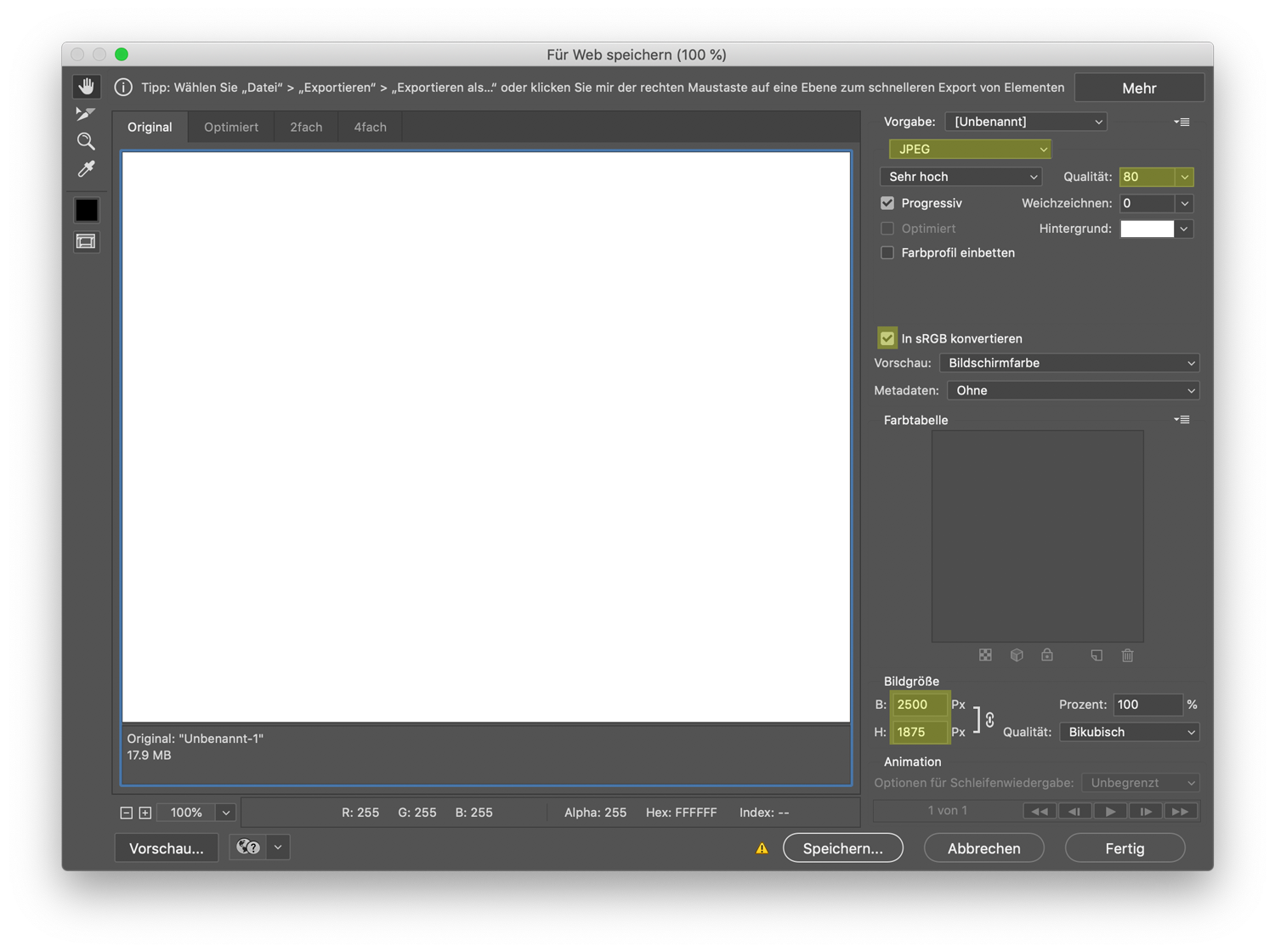
            • Note for exporting in Photoshop: 
              • File > Export > Save for Web
              • Quality: 80%
              • Option "Convert to sRGB" activated


          • No graphics or logos etc. on the photos except it applies directly to the product or project
          • No additional texts or letters on the photos (except the theme or work engages with the topic of text or linguistic)
          • No 3D-renderings oder sketches, photos should be real photos displaying the work!
          • Please take care of good contrast, brightness and light-shadow proportions
          • Ideally, the photos show the working prototype in interaction with people.

          Exhibition Video (optional)

          Project- or concept video

          Video in higher quality, please submit in the following sizes:

          1. a) 1280 x 720
          2. b) 1920 x 1080


          Dateityp:                                   Quicktime (.mov)

          Video Codec:                            H.264 compulsory (best quality)

          Key frame rate:                         25 FPS

          Audio Codec:                            AAC (advanced audio codec)

          Sample rate:                             48 kH


          Guidelines

          Start with a black or white screen, fade in over 1 second.

          Fade in sound from beginning of movie
           

          Credits

          If you are responsible for multiple aspects of the film (i.e you did everything yourself) simply list your credit under “Realization:”

          Please credit anyone with specific roles in the project.

          Show the IAD logoscreen at the end of the credits (server address)


      Website-Support
      Sie sind als Gast angemeldet (Login)
      Datenschutzinfos
      Laden Sie die mobile App
      Powered by Moodle


      2024, Zürcher Hochschule der Künste


      Datenschutz & Nutzungsbedingungen


      Impressum & Support


      Datenschutzrichtlinie Nutzungsbedingungen

      Urheberrechtsinhalte