-
Bits and Atoms IV
Mehr-
This seminar introduces technical skills for designing and prototyping spatial perception in machines. Such systems push new interactions between humans, machines, and the environment. Understanding and building such devices will equip students to confront many contemporary and future societal and ecological issues.
In the fourth semester, the course is closely tied to Spatial Interaction.
Key topics
- Networked Sensors
- Computer Vision
- Machine Learning
- Robotics
Deliverables
Participation in class discussions, completion of exercises, 80% attendance.
Documentation
Documentation/code should be placed on the server in smb://fileredu.ad.zhdk.ch/DDE/BDE_VIAD/01_ABGABEN/22_FS/Sem4_Bits&AtomsIV/
Documentation stands as evidence of attempting/completing the exercises. A copy of code in most cases will suffice, and in some cases, a photo or video of the outcome would be appropriate. Please clearly label and organise your folders so it's clear for which days and exercises the material relates.
-
23.03.202209:00 - 12:00Lecturer: Paulina
Topic : Computer Vision
30.03.2022 (4.T06) 09:00–12:00
Slides
Lecturer: Paulina
Topic : Computer Vision & p5.js
CV Examples: https://paul.zhdk.ch/pluginfile.php/178578/course/section/17275/Image%20Processing.zip
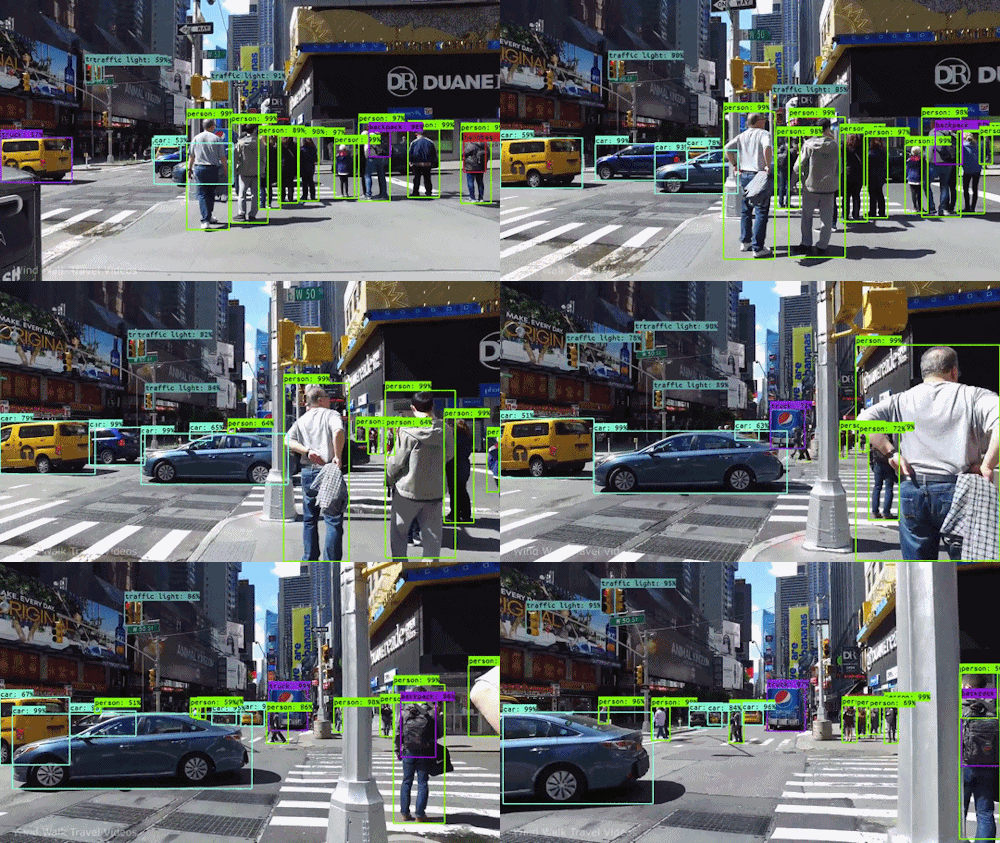
Open Data Cam 2.0 (Linux only)
Spatial interaction Examples (Florian Bruggisser)
ADOP: Approximate Differentiable One-Pixel Point Rendering Projects:
06.04.2022 (4.T37) 09:00–12:00
Slides
Lecturer: Luke Franzke
Topic : Networked Sensors - Sensors
13.04.2022 (4.T06) 13:00–17:00 (new time and location!)
Lecturer: Luke Franzke
Topic: Networked Sensors - Lora communication
20.04.2022 (5.T04) 09:00–12:00
Slides
Lecturer: Paulina
Topic: Machine Learning & Computer Vision
Machine Learning Principles:
Great Learning Resources:Other:
27.04.2022 (5.T04) 09:00–12:00
Lecturer: Luke Franzke, Paulina Zybinska
Topic : Robotics
Possible visit to dfab/Gramazio-Kohler Research -
Sensor investigationDust Sensor Module Kit - GP2Y1014AU0F with Cable– To measure the Sahara dustLORAThe Video from Silvan and me is on the server:
Sensor Exercise Part 1: Arduino Refresh
- Hook up the Environmental Combo to the MKR 1310
- Install the board profile (MKR 1310)
- Install the required libraries (CCS811 & BME280)
- Get a basic example up and running with a serial output
Sensor Exercise Part 2: Visualising Sensor Data (P5js refresh)
- Download the examples from the git repository for multiple inputs. Run a local server with Visual Studio Code
- Modify the Arduino code to output a single line of comma-separated values over serial
- Modify the visualisation to be mapped appropriately to the value ranges
- Label the channels on the visualisation
- Create new visuals suitable for the data
Briefly investigate a natural phenomenon and identify a sensor that may be able to measure this phenomenon. Add a link to the distributer's website (i.e Sparkfun or Adafruit).
Eleonora:
Sensor investigationDust Sensor Module Kit - GP2Y1014AU0F with Cable– To measure the Sahara dustDaniel:
I was looking into rainfall detection and found this simple sensor that looks like it can do the job.
Nicole
There are approaches to measure an aurora borealis with the help of seismographs:For Arduino I found a lot of DIY-sensors:
https://create.arduino.cc/projecthub/mircemk/sensitive-mpu6050-seismometer-with-data-logger-9e6bf5
Bin:A phenomenon I find interesting is the different qualities of light throughout the day.
https://en.wikipedia.org/wiki/Blue_hour
https://en.wikipedia.org/wiki/Golden_hour_(photography)
To measure that quality, we could use a combination of sensors:
Spectral colour sensor: https://www.adafruit.com/product/4698 or https://www.adafruit.com/product/3779
Real time Clock: https://www.adafruit.com/product/3013
Some sort of sensor to measure how to diffuse / focused the light is. Sadly, I could not find such a sensor.
Silvan:
Wassersensor:Sensor for detecting the presence of water such as in rainfall.101020018 - Grove - Water Sensor, Seeed StudioDistrelec Article Number: 300-69-804
Janosch & MiguelAttached are two videos which demonstrate what is possible with Ultra Wide Band (UWB). Indoor tracking with distance and angle. Miguel and I would like to look into this technology further. Would it be possible to order chips (DWM1000) like this?SandroA natural phenomena I picked was the development of dew in the morning. This could be measured with this sensor:Elenato measure the lake level after a rainfall one could use such a liquid level sensor. Maybe two stacked on top of each other for a longer range.https://www.adafruit.com/product/1786
Johannes
Not a too extravagant natural phenomena I chose: Volcanic Eruption. (Could be obviously used for a lot of different ones as well)Mainly because the sensor looks interesting to me.It’s a thermal imaging module with the camera core made by FLIR. Found it interesting to see a module with such a high resolution in that price scale. Mostly does IR-Sensors have a resolution of around 32x32 which makes them quite limiting for recognition purposes.Here the link to the sensor:Another sensor I didn’t choose (asked Paulina before if it would be possible to get one) but is really nice is a string potentiometer. Know them from my working experiences. As far as I know you don’t have one at the lab. These are not as common, but super useful in certain situations (non linear motion, no clear view on travel distance, interference from outside, material constrains, spacial constraints).Because they are not that common, there aren’t any good cheap variants on the western markets. You mostly find professional sensors in the range of upwards of a thousand franks.Searched for them on aliexpress and actually found something that is “affordable”. Would be super cool to have one of those in the lab if needed. -
LORA Exercise Part 1: Basic Communication
- Install the Lora library by sandeepmistry with the library manager.
- With a partner, send some simple messages between two devices. See the first examples here for sending and receiving.
- Turn your devices into a one-way txt messenger, by relaying messages that are input into the serial terminal. (advanced option, make it two way)
LORA Exercise Part 2: Just getting what you want
- Modify your last example to use a unique ID for identifying the messages sent between you and your partner. See here on how to do that.
- Combine examples from this week and last, to send sensor information over Lora
- Put your sensor into the field and try to send and receive messages between devices over a longer distance
- Use your phones keep in touch and see how far apart you can get
-
Using the results from the exercise from the last week divide yourself in four groups; two Receivers(R) and two Senders(S).
- S: Hookup environmental sensor to MKR 1310 in the same way as last week and open up the sketch which sends the data.
- R: Open up the sketch which receives the data.
- R and S: Choose together two sensor values and collect data from two different environments. Make sure you end up with one training data set (1000 examples) and one test data set (100 examples)
- R: Train ML model which either:
- Recognises the right environment for the new values.
- Predicts one environmental value based on the other
- Choose one of the provided templates to train your own model.
- R + S: Create a sketch that represents the classified environment in a visual way.
Upload to : smb://fileredu.ad.zhdk.ch/DDE/BDE_VIAD/01_ABGABEN/22_FS/Sem4_Bits&AtomsIV/
-